Updated March 29, 2026 — All product picks reviewed against Montessori education principles. Prices verified.
Montessori toys for 1 year olds look nothing like the flashing, beeping toys that fill most store shelves. That is by design. The Montessori approach favors simple, purposeful objects that let children learn at their own pace through hands-on exploration rather than passive entertainment.
But “Montessori” has become a marketing buzzword. Not every toy labeled Montessori actually follows the philosophy. In this guide, we explain what genuinely makes a toy Montessori-aligned, recommend 10 excellent options for children around age 1, and outline which toys work best at each developmental stage.
What Makes a Toy “Montessori”?
Dr. Maria Montessori never designed toys. She designed learning materials based on specific principles. A truly Montessori-aligned toy shares these characteristics:
- Made from natural materials: Wood, cotton, metal, and glass (age-appropriate) over plastic
- One skill at a time: Isolates a single concept (color, size, shape) rather than combining everything
- Self-correcting: The child can see whether they got it right without adult intervention
- Open-ended: No single “correct” way to play — the child leads
- Real-world connected: Relates to practical life skills or real objects
- No batteries: The child is the active agent, not the toy
Not every toy on our list hits all six criteria perfectly, but each one aligns with the core Montessori philosophy of child-led, purposeful play.
The 10 Best Montessori Toys for 1 Year Olds
#1 Montessori Wooden Beads Sequencing – $12.54

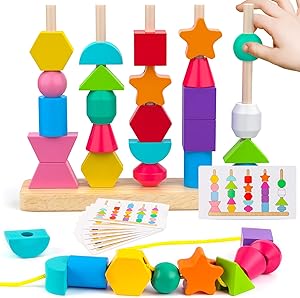
This is the most classically Montessori toy on our list. Graduated wooden beads in natural and colored finishes teach size sequencing, a core Montessori sensorial concept. The child can arrange them by size (self-correcting — wrong order is visually obvious), thread them for fine motor practice, or sort by color. No lights, no sounds, just beautifully crafted wood and purposeful design.
Montessori principles: Natural materials, self-correcting, isolates one concept (size), open-ended
- True-to-Montessori design
- Beautiful natural wood finish
- Multiple play modes (sequence, thread, sort)
- Grows with child from 6m to 3y
- Smaller beads require supervision
- Less immediately “exciting” than electronic toys
Check Price on Amazon – $12.54
#2 JoyCat Baby Beehive Sensory Toy – $19.18

Five bees fit into matching honeycomb cells, teaching color matching and developing the pincer grasp that Montessori educators consider essential for later writing. The sorting action is self-correcting (each bee fits only one way), and the natural bee/hive concept connects play to the real world. At 4.9 stars from 966 reviews, this is a parent favorite for good reason.
Montessori principles: Self-correcting, fine motor isolation, real-world connection, no batteries
Check Price on Amazon – $19.18
#3 Montessori Magnetic Fishing Game – $12.24

A wooden fishing board with magnetic fish and a fishing pole. This is a masterclass in isolating a single skill: hand-eye coordination. The child must steady the pole, align the magnet, and lift the fish — all requiring patience and precision. The wooden construction and natural theme keep it grounded in Montessori values.
Montessori principles: Natural materials, single-skill focus, patience-building, real-world connection
Check Price on Amazon – $12.24
#4 Wooden 7-in-1 Activity Cube – $15.62
While a multi-activity cube is not strictly Montessori (it combines multiple skills), this wooden version earns its place because each face isolates a different activity. The child naturally focuses on one side at a time, rotating the cube when ready for a new challenge. The all-wood construction, absence of batteries, and hands-on manipulation align well with Montessori values.
Montessori principles: Natural materials, hands-on manipulation, child-directed exploration
Check Price on Amazon – $15.62
#5 OESSUF Stacking Rocks 16pcs Wooden – $19.92

These smooth, irregularly shaped wooden stones are Montessori at its purest. There are no instructions, no correct answer, and no limit to what a child can create. Balancing stones of different sizes and weights teaches physics intuitively, develops spatial reasoning, and builds concentration. They also double as beautiful shelf decor.
Montessori principles: Open-ended, natural materials, self-directed, no batteries
Check Price on Amazon – $19.92
#6 Fisher-Price Wood Stack & Sort Animals – $11.95

Fisher-Price brings Montessori-friendly design to a mainstream price point. Wooden animal-themed stacking pieces in natural finishes combine sorting and stacking into a visually appealing set. The self-correcting graduated sizes mean the child can see when the order is wrong without being told.
Montessori principles: Natural materials, self-correcting, size sequencing
Check Price on Amazon – $11.95
#7 Busy Board Montessori – $14.75

A felt board with real-world fasteners: zippers, buttons, buckles, snaps, and laces. This is practical life skills training — a cornerstone of Montessori education. Learning to zip, button, and buckle builds independence (getting dressed alone) while developing fine motor control. The portable design makes it perfect for travel.
Montessori principles: Practical life skills, real-world connection, independence-building, child-directed
Check Price on Amazon – $14.75
#8 Wooden Montessori 3-in-1 Fine Motor Set – $17.36

Three wooden activities — bead threading, shape sorting, and color matching — each isolating a different fine motor skill. The set allows the child to choose their own challenge level, a key Montessori principle. Natural wood construction and thoughtful sizing make this appropriate for children just turning 1.
Montessori principles: Natural materials, skill isolation, self-directed choice
Check Price on Amazon – $17.36
#9 Joyreal Wooden Hammering Toy – $18.44
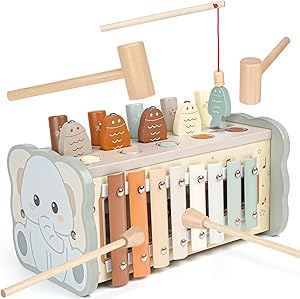
A pounding bench with wooden pegs and a mallet. When you hammer one peg down, another pops up — a simple cause-and-effect mechanism that fascinates toddlers. The repetitive, purposeful action builds arm strength, hand-eye coordination, and the satisfaction of physical work. Very much aligned with Montessori’s emphasis on purposeful movement.
Montessori principles: Cause and effect, purposeful movement, natural materials, no batteries
Check Price on Amazon – $18.44
#10 Melissa & Doug Building Blocks 100pc – $15.31

One hundred solid wood blocks are the ultimate open-ended Montessori material. No instructions, no app, no single purpose. A 1 year old will knock towers down. A 2 year old will stack them. A 3 year old will build castles. The learning is entirely child-directed, and the natural wood blocks develop spatial reasoning, physics intuition, and creativity that no electronic toy can match.
Montessori principles: Open-ended, natural materials, progressive difficulty, child-directed
Check Price on Amazon – $15.31
Montessori Toy Progression: What to Introduce When
10-12 Months: First Explorations
At this stage, children are developing their pincer grasp, beginning to stand, and exploring cause and effect.
- JoyCat Beehive — simple sorting with large, graspable pieces
- Fisher-Price Wood Stack & Sort — first stacking experiences
- Simple object permanence boxes (place ball in hole, it reappears)
12-18 Months: Building Independence
Toddlers are walking, using a more refined grasp, and beginning to understand how objects relate to each other.
- Wooden Beads Sequencing — size ordering and threading
- Joyreal Hammering Toy — purposeful gross motor work
- Activity Cube — multi-station exploration
- 3-in-1 Fine Motor Set — threading and shape sorting
18-24 Months: Concentration and Precision
Children can now focus for longer periods, follow simple sequences, and begin pretend play.
- Magnetic Fishing Game — precision and patience
- Busy Board — practical life skills (zipping, buttoning)
- Stacking Rocks — open-ended balancing challenges
24-36 Months: Creative Construction
By age 2, children are ready for more complex building, extended imaginative play, and increasingly difficult fine motor challenges.
- Melissa & Doug 100 Blocks — unlimited building possibilities
- More complex threading and lacing activities
- Practical life tools: child-sized broom, watering can, food preparation
How to Set Up a Montessori Play Space
You do not need an expensive overhaul. Follow these simple principles:
- Low, open shelving: Place 4-6 toys on a low shelf where the child can see and reach them independently
- Rotate weekly: Swap toys in and out to maintain interest without overwhelming
- Each toy has a place: Use baskets or trays so the child learns to take out and put back
- Less is more: Too many choices lead to unfocused play. Fewer options mean deeper engagement
- Child-height everything: Mirror, art on the wall, and shelves should be at the child’s eye level
Montessori Toys vs. Traditional Toys: What the Research Says
A 2024 study in Frontiers in Psychology found that children given fewer, simpler toys played more creatively and for longer periods than children given many electronic toys. The key findings:
- Children with open-ended toys showed 2x longer sustained attention
- Pretend play increased significantly with real-world connected toys
- Electronic toys led to more passive behavior and less verbal interaction
- Natural materials were handled more carefully, teaching respect for objects
This does not mean all electronic toys are bad. The LeapFrog 100 Words Book, for example, uses electronics purposefully to teach vocabulary. The key is balance — lead with open-ended Montessori toys and supplement with well-designed electronic options.
Common Montessori Toy Mistakes to Avoid
- Buying “Montessori” without checking: Many toys use the Montessori label for marketing. Check if it actually follows the principles above
- Too many toys at once: A Montessori shelf with 20 toys defeats the purpose. Start with 4-6
- Rushing the progression: A toy that is too advanced leads to frustration. Match the toy to the child’s current ability, not where you want them to be
- Skipping practical life: Real objects (a small broom, a pouring pitcher, a dressing frame) are more Montessori than any toy
Related Guides
For our complete ranked list of toddler toys, visit our Toddler Toys 1-3 Years collection. Looking for toys for younger babies? Browse our Baby Toys 0-12 Months picks, which include several Montessori-aligned options for infants.
This article contains affiliate links. We may earn a small commission at no extra cost to you. All prices shown were accurate at the time of publication.