Updated March 29, 2026 — Product picks verified, developmental milestones reviewed with pediatric occupational therapy guidelines.
Sensory toys for babies are not just playthings. They are tools that help wire a developing brain. Every texture a baby touches, every sound a rattle makes, and every color that catches their eye builds neural pathways that support learning, movement, and emotional regulation.
But not all sensory toys are created equal. The best ones engage multiple senses at once, grow with your baby through different stages, and hold up to months of mouthing, dropping, and throwing. Here are our top 10 picks, plus a developmental guide organized by age.
What Makes a Great Sensory Toy?
A quality sensory toy should stimulate at least two of the five senses simultaneously. Look for toys that combine:
- Touch: Multiple textures — smooth, bumpy, ridged, soft
- Sound: Rattles, crinkles, music (not overly loud)
- Sight: High contrast patterns (0-3m), bright colors (3m+)
- Cause and effect: Baby does something, something happens
- Movement: Encourages reaching, grasping, crawling
The 10 Best Sensory Toys for Babies
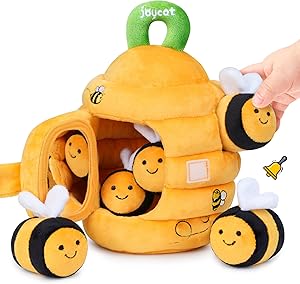
#1 JoyCat Baby Beehive Sensory Toy – $19.18

Our overall favorite sensory toy. Five soft bees slot into a honeycomb base, engaging touch (different textures on each bee), sight (vibrant colors), and fine motor skills (pincer grasp to pick up bees). The sorting action introduces early problem-solving, and the satisfying “fit” when a bee finds its cell rewards persistence.
Senses engaged: Touch, sight, spatial awareness
4.9 stars (966 reviews) | Ages 6m+
#2 Bright Starts Oball Classic Ball – $4.12
The Oball is a sensory masterpiece in its simplicity. The flexible lattice design lets even newborns grip it, and the ball bounces, rolls, and squishes unpredictably. Babies learn cause and effect (throw it, it bounces back), develop grip strength, and explore the unique texture of the interwoven strands. At $4.12, it is the best sensory value available.
Senses engaged: Touch, sight, proprioception
4.9 stars (434 reviews) | Ages 0m+
#3 Bright Starts Little Shakers 6pc Oball Set – $19.96

Six distinct rattles, each with a different shape, texture, and sound. This variety is key for sensory development — babies learn to discriminate between different tactile and auditory inputs. The Oball finger-hole design means every piece is graspable from birth. Parents love that each rattle engages differently, keeping play sessions varied.
Senses engaged: Touch, sound, sight
4.9 stars (708 reviews) | Ages 0m+
#4 Fisher-Price Rattle Rock Maracas – $7.49

A textbook cause-and-effect toy. Baby shakes, beads rattle. The feedback loop is immediate and satisfying, teaching babies that their actions create results. The textured handles add a tactile dimension, and the bright colors provide visual stimulation. Simple, effective, and backed by decades of Fisher-Price safety engineering.
Senses engaged: Sound, touch, sight
4.8 stars (894 reviews) | Ages 3m+
#5 Nuby Ice Gel Teether Keys – $3.72

Teething is a full-body sensory experience, and these ice gel keys address it from every angle. Multiple textures reach different parts of the gums, the cold gel soothes inflammation, and the bright key shapes attract visual attention. The ring handle is easy to grip during those frustrating teething moments when fine motor control drops.
Senses engaged: Touch (temperature + texture), sight
4.7 stars (879 reviews) | Ages 3m+
#6 Musical Crawling Crab Plush – $17.35
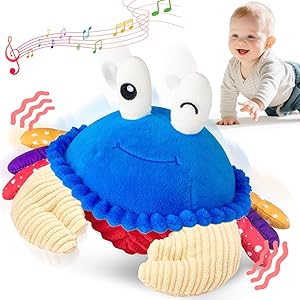
This toy combines auditory stimulation (40 songs and sounds), visual tracking (baby follows the moving crab), and gross motor motivation (crawling to catch it). The plush texture adds a comforting tactile element. It is one of the few sensory toys that actively encourages movement, making it ideal for the 6-9 month crawling window.
Senses engaged: Sound, sight, touch, movement
4.5 stars (788 reviews) | Ages 6m+
#7 Learning Resources Spike the Fine Motor Hedgehog – $10.39
Spike is a sensory favorite among pediatric occupational therapists. The chunky quills provide tactile feedback as they pop in and out. Each quill is a different color for visual sorting, and the satisfying “click” when a quill seats properly gives auditory confirmation. This multi-sensory feedback loop makes it deeply engaging for babies 6 months and up.
Senses engaged: Touch, sight, sound (click), fine motor
4.7 stars (544 reviews) | Ages 6m+
Check Price on Amazon – $10.39
#8 Wooden 7-in-1 Activity Cube – $15.62
A sensory buffet. Seven different activities on one cube mean seven different tactile, visual, and cognitive experiences. Spinning gears teach cause and effect. Bead mazes develop hand-eye coordination. Shape sorters combine touch and spatial reasoning. The wooden construction adds a natural warmth that plastic cannot replicate.
Senses engaged: Touch, sight, sound, spatial awareness
4.5 stars (789 reviews) | Ages 6m+
#9 Sassy Stacks of Circles STEM – $7.81

Each ring has a different texture, weight, and size, providing a rich tactile comparison as baby handles them. The weighted wobble base adds an element of unpredictability that engages visual tracking. The center pole is flexible, forgiving early stacking attempts while teaching hand-eye coordination.
Senses engaged: Touch (texture variety), sight, balance
4.8 stars (645 reviews) | Ages 6m+
#10 Baby Gym Play Mat – $22.26

A complete sensory environment. The overhead arch with dangling toys creates visual tracking opportunities. The padded mat offers tummy-time tactile stimulation. Hanging mirrors, crinkle toys, and teethers engage multiple senses simultaneously. This is the closest thing to a sensory gym for babies who cannot yet sit up.
Senses engaged: Touch, sight, sound, proprioception
4.0 stars (738 reviews) | Ages 0m+
Sensory Play Milestones by Age
0-3 Months: Discover the World
Newborns see best at 8-12 inches and prefer high-contrast patterns. Their hearing is already well-developed, but their grasp reflex is involuntary.
What to offer:
- High-contrast black and white toys or cards
- Soft rattles with gentle sounds (Oball Classic is perfect for accidental grasping)
- Tummy time mat with overhead toys (Baby Gym Play Mat)
- Skin-to-skin contact — the original sensory experience
Skills developing: Visual tracking, auditory localization, head control
3-6 Months: Reach and Grasp
Babies begin reaching for objects intentionally, transferring items between hands, and bringing everything to their mouths. Color vision is fully developed by 5 months.
What to offer:
- Rattles they can shake on purpose (Fisher-Price Maracas)
- Teethers with varied textures (Nuby Ice Gel Teether Keys)
- Multi-texture rattle sets (Little Shakers 6pc)
- Crinkle books and fabric toys
Skills developing: Voluntary grasp, bilateral hand use, oral exploration, cause and effect
6-12 Months: Explore and Experiment
This is the golden age of sensory play. Babies sit independently, crawl, and start using a pincer grasp. They actively seek out new textures, sounds, and visual experiences.
What to offer:
- Sorting and fitting toys (JoyCat Beehive, Spike the Hedgehog)
- Stacking toys with textured rings (Sassy Stacks)
- Activity cubes with multiple stations (7-in-1 Activity Cube)
- Crawling-motivation toys (Musical Crawling Crab)
- Water play and textured balls
Skills developing: Pincer grasp, object permanence, spatial reasoning, crawling, early problem-solving
How to Create a Sensory Play Routine
You do not need an elaborate setup. Here is a simple framework:
- Start short: 5-10 minutes of focused sensory play is plenty for babies under 6 months
- Follow their lead: If baby is fascinated by a texture, let them explore it fully before introducing the next thing
- Rotate toys weekly: Put 3-4 sensory toys out at a time. When interest wanes, swap in a “new” set from the rotation
- Engage with them: Narrate what they are touching and hearing: “That feels bumpy. Do you hear the rattle?”
- Watch for overstimulation: Fussiness, turning away, or arching the back are signs baby needs a break
Signs Your Baby Benefits from Sensory Play
- Reaches for objects with increasing accuracy
- Turns head toward sounds
- Explores toys with both hands and mouth
- Shows preference for certain textures or sounds
- Calms down when given a familiar sensory toy
- Becomes more focused during play sessions over time
Related Guides
For our full ranked list of baby toys, read The Best Baby Toys for 0-12 Months. Ready for the next stage? Explore our Toddler Toys for 1-3 Years collection for sensory toys that grow with your child.
This article contains affiliate links. We may earn a small commission at no extra cost to you. All prices shown were accurate at the time of publication.